Showing posts with label disciplinary. Show all posts

Tuesday, January 31, 2023

Chapter 3. Judge Joseph Ellis States Corrupt Court Officials Must Be Protected

Judge Ellis Final Order Protects Corrupt Court Officers and Judges

February 1, 2023. Author- Brace Impact

      On January 13, 2023, Judge Joseph Ellis issued his Memorandum Opinion and Order in four complaints filed in the Henrico County Circuit Court, dismissing the complaints and imposing an injunction on Nickolas Spanos from filing any further ethics complaints exposing corruption in the Commonwealth of Virginia.

     The complaints against corrupt court officials filed by Spanos were supported by hundreds of pages of evidence which included FBI reports, court documents, emails of court clerks stating that records and filings were tampered with, tampered court records sent to the Court of Appeals, Judge’s false statements, and numerous other documents that the defendants had accepted bribes in exchange for financial and political favors.

      The Memorandum Opinion was unethically written for Judge Ellis by McGuireWoods Counsel Brandon Santos, the attorney for Defendants Richard Cullen, James Comey, Howard Vick, William Birch Douglass III, and William Hutchens, who were previous attorneys with McGuireWoods law firm in Richmond, Virginia.

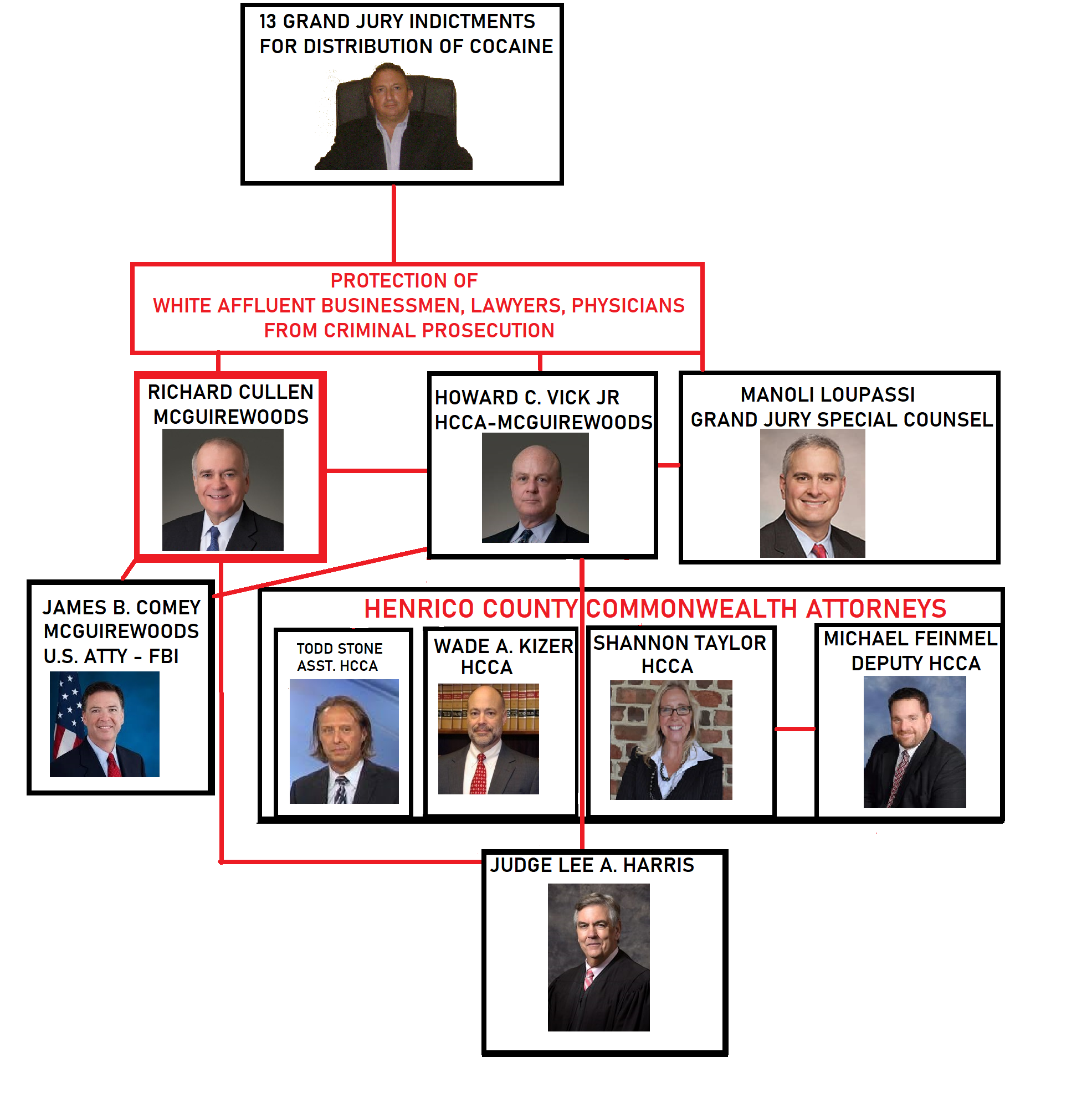
     The five McGuireWoods attorneys were accused of supporting and promoting a "White Nationalism Doctrine" along with seven co-defendants that gave special legal protection and treatment to the white, affluent middle to upper-class professionals who were clients attorneys of McGuireWoods law firm that were involved in a 600-kilo cocaine organization. As a result, the white, affluent professionals were protected from being investigated and charged for their role in the 600-kilo cocaine organization.

    The Plaintiff, Nickolas Spanos, had submitted evidence of FBI reports, court documents, and other evidence that exposed the McGuireWoods Shadow Government headed by Richard Cullen. Additionally, the complainant gave evidence that Richard Cullen had bribed several Henrico County Commonwealth Attorneys, Judges, U.S. Attorneys, and other court officials to obstruct justice in the Spanos cocaine case. 

    Spanos filed a Motion for Judge Joseph Ellis to Recuse Himself from hearing any of the ethics complaints. The Motion gave evidence of Judge Ellis's close financial relationship with McGuireWoods law firm, Richard Cullen, and having ex parte communications with Brandon Santos. Judge Joseph Ellis who works as a mediator for Juridical Solutions has a financial conflict of interest as McGuireWoods law firm is a client of Juridical Solutions, which Judge Ellis mediated litigation for McGuireWoods. Judge Joseph Ellis is paid $400 per hour for his mediation service and the average mediation is 30-50 hours. See link below:

https://juridicalsolutions.com/professionals/hon-joseph-j-ellis-ret-juridical-solutions-mediation-arbitration/

   Judge Ellis was ethically obligated to rule on the Motion to Recuse himself before presiding over the hearing, Judge Ellis refused to rule on the Motion to Recuse Himself and conducted the ethics complaint hearings which violated numerous judicial canons of Virginia. 

   The Memorandum Opinion and Order written for Judge Ellis by McGuireWoods defense counsel Brandon Santos has given evidence of judicial misconduct by Judge Ellis which Judge Ellis and Brandon Santos had ex parte communications on the details of the Memorandum Opinion and Order that Brandon Santos drafted for Judge Ellis to sign. The Memorandum Opinion and Order was signed at the end of the January 13, 2023, hearing, giving further evidence that ex parte communications took place between Judge Ellis and Brandon Santos.

    Despite Judge Ellis issuing an order on September 19, 2022, dismissing the four complaints filed by Spanos, Judge Ellis suspended the order to unethically allow McGuireWoods Brandon Santos to file a Pre-Filing Injunction on October 5, 2022. The Pre-Filing Injunction ordered Spanos not to file further ethics complaints in the Commonwealth of Virginia. Yet, each Virginia circuit court has jurisdiction over filings submitted to it and other courts cannot prohibit any court filing. 

    The Memorandum Opinion and Order contradicts itself throughout the Final Order and gives evidence of further corruption of judges, which states in part:

    "Upon consideration of the Motion, briefs, and presentations at oral argument, the Court determines that a pre-filing injunction is merited. In determining whether a pre-filing injunction is substantively warranted, a court must weigh all the relevant circumstances, including (1) the party's history of litigation, in particular, whether he has filed vexatious, harassing, or duplicative lawsuits; (2) whether the party had a good faith basis for pursuing the litigation or simply intended to harass; (3) the extent of the burden on the courts and other parties resulting from the party's filings; and (4) the adequacy of alternative sanctions."

How can Judge Ellis rule on the Pre-Filing Injunction which he had ruled that the Court has no jurisdiction to hear the matter further. McGuireWoods did not file a separate Motion for Injunction but filed the Pre-Filing Injunction after Judge Ellis issued an order stating that the Court did not have jurisdiction in this matter and no further rulings were necessary.      

  "First, in addition to the above-captioned cases, the Plaintiff’s history of litigation shows he has filed many duplicative, vexatious lawsuits generally alleging "ethics complaints" against various attorneys and judges in the central Virginia region."

   "Second, and to this end, Plaintiff’s "ethics complaint[s]" in these cases are intended to harass. As noted above, Plaintiff has repeatedly asserted this cause of action in circuit courts of the Commonwealth, and not once has he been successful. That is for good reason, as authorities in Virginia have long held that the Code does not afford Plaintiff standing to bring an ethics complaint in this Court."

The Plaintiff proved that he met the requirements to have standing in filing complaints against attorneys who harmed him and others by their actions and provided hundreds of pages of evidence to support his allegations. 

The Defendants in their Demurrers and Plea in Bar never denied the allegations and failed to defend themselves, only stating that their misconduct was protected by judicial and prosecutorial immunity.

     "Third, the burden on this Court and Defendants has been significant. Plaintiff’s Complaints in the above-captioned matters required the recusal of all sitting judges in the Henrico County Circuit Court. And, as noted above, Plaintiff has filed multiple suits in multiple jurisdictions across central Virginia, none of which have succeeded. Plaintiff has also extended the burden of his various baseless claims into appellate courts, where he is currently pursuing seven appeals at the state and federal level relating to the above-referenced "ethics complaints" filed in Henrico, Richmond, and Louisa. See Spanos v. Gibney, Case No. 22-2246 (4th Cir.) (removed from Spanos v. Gibney, CL 22-2249 (Henrico)); Spanos v. Vick, et al., CAV Record No. 1558-22-2; Spanos v. Vick, CAV Record No. 1554-22-2; Spanos v. Douglass & Hutchins, CAV Record No. 1553-22-2; Spanos v. Freed, et al., CAV Record No. 0706-22-2; Spanos v. Feinmel, CAV Record No. 0140-2202; Spanos v. Taylor; CAV Record No. 0139-22-2."

The Plaintiff has the right to petition the courts under the Fourteenth Amendment of the U.S. Constitution and has filed his complaints according to Virginia Statutes concerning the discipline of attorneys who violate the rules of the Virginia Code of Professional Conduct.

Even the Virginia State Bar's Deputy Intake Officer Jane Fletcher stated to Spanos through numerous letters supporting the Plaintiff's right to take civil action against attorneys who acted unethically and the Virginia Courts had jurisdiction to discipline attorneys. 

     "To this end, Plaintiff argues in his "Objections to the Defendants Pre-Filing Injunction" that his appeals of the above-captioned cases divested this Court of jurisdiction to hear the Motion. But this Court-in accordance with Rule 1: 1 of the Rules of the Supreme Court of Virginia-clearly suspended the order dismissing his Complaints with prejudice so that it would retain jurisdiction to hear the Motion. In this respect, the Plaintiff’s attempt to wield his appellate filings as a shield against the Motion further demonstrates the undue burden he has imposed on the judicial system."

How can Judge Ellis rule in his Final Order that the Court does not have jurisdiction to hear this matter, yet Judge Ellis rules on the Pre-Filing Injunction which is part of the matter and was filed after he issued his final order, even stating; "Given this ruling, it is not necessary for the Court to rule on other motions and defenses filed by Defendants to Plaintiff s Complaint.”

   "Finally, this Court has an obligation to protect the Court, its staff, the Defendants, and future defendants, from the harassment and expense of unfounded litigation, and to preserve valuable judicial resources. For these reasons, imposing a pre-filing injunction is an appropriate sanction under this case and the many similar cases Plaintiff has filed across the Commonwealth."

No, the Court has an obligation to serve and protect the public first and foremost, to insure that justice is served and to report unethical misconduct by attorneys and judges. The Court is obligated to follow the U.S. Constitution, Judicial Canons of Virginia, Virginia Statutes, and the SCV Rules of Court. Its obligation is not to protect the McGuireWoods shadow government that has created a criminal syndicate in the Virginia Judicial system.  

"It is therefore ORDERED, ADJUDGED, and DECREED that Plaintiff is enjoined from any further filings in this Court, or in any other court in the Commonwealth of Virginia without first obtaining leave from this Court. As a part of any motion for leave to file any such pleading or filing, Plaintiff must attach a copy of this Memorandum Opinion & Order and a detailed written statement explaining why such pleading or filing is materially different from the "Ethics Complaints" filed against the Defendants in the above-captioned actions."

Judge Ellis has violated his own Final Order, how can he order the Plaintiff not file further ethics complaints when he has ruled that the Court has no jurisdiction in this matter?  

Judge Ellis contradicts his own order, as he is stating that the "Plaintiff is enjoined from any further filings in this Court, or in any other court in the Commonwealth of Virginia without first obtaining leave from this Court", Judge Ellis is giving a clear message that Virginia Courts have jurisdiction to hear ethics complaints against attorney unethical misconduct, otherwise Judge Ellis would have stated that the Plaintiff is enjoined from filing any further ethics complaints in Virginia Courts as they do not have jurisdiction to hear these matters.

A footnote at the end of the order ironically states that Judge Ellis's Final Order is without standing:

    "This Court does not restrict whether another court of this Commonwealth can accept filings from Plaintiff, only that Plaintiff will face contempt in this Court for failure to comply with this Memorandum Opinion & Order or the accompanying court orders." 

    Judge Ellis is threatening Spanos with contempt of court, knowing that Spanos has 13 outstanding indictments for the distribution of cocaine and was publicly accused by the Henrico Commonwealth Attorneys’ office for being the "hub of a 600-kilo cocaine organization that operated in the Richmond, Virginia area for over ten years". The basis of the Complaints filed by Spanos is that numerous DOJ and court officials accepted bribes to refuse the extradition and prosecution of Spanos to prevent him from testifying against white, affluent McGuireWoods attorneys and clients.


Sunday, January 22, 2023

Chapter 1. EVIDENCE OF MCGUIREWOODS SHADOW GOVERNMENT IN VIRGINIA COURTS

 Judges' Orders Further Exposes the McGuireWoods Shadow Government Corruption

January 22, 2023. Author- Brace Impact


     After 14 months, decisions were issued concerning four complaints filed in the Henrico County Circuit Court against 10 high-profile attorneys consisting of judges, prosecutors, and high profile attorneys including Richard Cullen, the Chief Legal Advisor for Virginia Governor Glenn Youngkin.

    As alleged in the complaints filed, Judge Joseph Ellis's Memorandum Opinion and Order issued on January 13, 2023, gave further evidence that McGuireWoods Shadow Government, headed by Richard Cullen, controls the Judicial system in the Virginia Courts. No matter the crimes committed by Virginia Shadow Government lawyers and the legal arguments presented by Plaintiffs, the judges will disregard the U.S. Constitution and Rules of Court and always rule in favor of McGuireWoods Shadow Government.

    The highly controversial case forced the recusal of five Henrico County Circuit Court judges and three other judges designated by the Virginia Supreme Court.  Judge Wilford Taylor had recused himself after evidence filed in the cases proved he had ex parte communications with third parties which he reversed a previous order allowing Spanos to give testimony by two-way audio-video communications. Judge Joseph Ellis denied Spanos's Motions to appear by two-way audio-video and give testimony.


     The defendants listed in the ethics complaints are:
  • Richard Cullen
  • James B. Comey
  • Howard Vick
  • Judge Lee A. Harris
  • Shannon Taylor
  • Michael Feinmel
  • Heidi Barshinger
  • George Manoli Loupassi
  • Wade Kizer
  • Todd Stone
  • William Birch Douglass III
  • William Hutchins
    

    The Defendants filed Demurrers and Pleas of Immunity stating that their unethical misconduct and crimes were protected by judicial and prosecutorial immunity. The Defendants did not deny the allegations of bribery, obstruction of justice, destroying evidence, forgery and several constitutional violations in the complaints.  
     
     Evidence filed in the complaints depicted that McGuireWoods law firm operates the Virginia Shadow Government, headed by Richard Cullen, which controls the three branches, Judicial, Legislative, and Executive, of the Commonwealth of Virginia. The complaints further stated that McGuireWoods law firm has infiltrated the DOJ and FBI by placing McGuireWoods attorneys in key positions and controlling the manner of which the FBI and DOJ is operated.
    
     The complaints gave hundreds of pages of evidence that the 10 high profile attorneys promoted and supported a "white nationalism doctrine" which gave special legal treatment and protection to over 30 white affluent professionals consisting of lawyers, doctors and businessmen who were involved in a 600 kilo cocaine organization that operated in the Richmond area for over 10 years. Many of the white affluent professionals were clients of McGuireWoods law firm and connected to Richard Cullen. 

    The complaints filed by Nickolas Spanos, who had been accused of being the "hub" of the 600-kilo cocaine organization, gave evidence of bribery, political favors, and a criminal syndicate that operated in the Henrico County Circuit Court. Spanos who has been protected by the Henrico Commonwealth Attorney's office and kept in exile, so that he could not testify against the affluent white professionals who were involved in the 600-kilo cocaine organization. Despite having 13 indictments for the distribution of cocaine, the Henrico Commonwealth Attorney's office has refused to extradite Spanos to Henrico County.

    The complaints gave evidence, which included FBI reports and court documents that Richard Cullen obstructed justice and bribed Henrico Commonwealth Attorneys to protect Spanos from being arrested and extradited to Henrico County to face the 13 indictments for distribution of cocaine amounting to 600 kilos. Court documents stated that Cullen, managing partner for McGuireWoods law firm, did not want Spanos prosecuted for the 13 indictments as it would lead to Spanos testifying against the affluent white professionals who were attorneys employed by McGuireWoods or clients of McGuireWoods.

     Spanos and his family were clients of McGuireWoods, under Richard Cullen's management, with estate holdings in the millions of dollars. Richard Cullen bribed Henrico County Commonwealth Attorney Howard Vick with a partners position with McGuireWoods law firm in exchange for his refusal to file an extradition request for Spanos while he was in Greece. The USA and Greece have had an extradition treaty since 1937 and Spanos had no protection from being extradited.

    On January 13, 2023, Judge Joseph Ellis issued orders for:
Case No. CL21005758 Spanos v. Vick, 
Case No. CL21005759 Spanos v. Douglass et al., 
Case No. CL21006572 Spanos v. Vick et al.
Case No. CL22002250 Spanos v. Harris et al.

   The orders dismissed Spanos's complaints stating that Spanos did not have standing and the Court did not have jurisdiction to discipline attorneys accused of violating the Rules of the Virginia Code of Professional Conduct (VCPC).

    Spanos gave evidence that Virginia Codes, Rules of the Supreme Court of Virginia, Virginia Supreme Court and United States Supreme Court cases and the Virginia State Bar dictated that only Virginia Courts have the authority and jurisdiction to discipline attorneys who violate the rules of the VCPC. Judge Joseph Ellis ignored the Virginia Legislature, Virginia Supreme Court rules, Virginia and U.S. Supreme Court opinions and Virginia State Bar letters which all supported Spanos's assertions that Virginia Courts have jurisdiction in attorney disciplinary hearings.

    Spanos filed motions for Judge Joseph Ellis to recuse himself because he violated the Virginia Judicial Canons by having a conflict of interest concerning the defendants, specifically Richard Cullen and other McGuireWoods defendants. Judge Joseph Ellis refused to address the motion to recuse himself and neglected to issue an order.

    Spanos also filed an Objection to a Pre-Filing Injunction submitted by McGuireWoods which sought to prohibit Spanos from filing ethics complaints in the entire Commonwealth of Virginia. Spanos based his objection that McGuireWoods attorneys violated Va. Code § 8.01-271.1. which contained signature defects and gave notice that they were required to be remedied within 21 days of notice by Spanos. McGuireWoods attorneys Brandon Santos, Garret Hooe, and Ellen Hubbard, had unethically signed the Pre-Filing Injunction without being authorized to represent the other 7 defendants who had their own counsel of record.

    Judge Joseph Ellis unethically neglected to rule on Spanos's Motions and issued his Memorandum Opinion and Order without addressing the two important motions filed by Spanos.

    Despite the dismissal of the ethics complaints, Judge Joseph Ellis' Memorandum Opinion and Order undeniably proves that Virginia Judges are controlled by McGuireWoods Shadow Government headed by Richard Cullen and despite the hundreds of pages of evidence proving that a criminal syndicate exists in the Henrico County Circuit Court which supported and promoted "white nationalism", Virginia's citizens are left unprotected and have no constitutional rights to file complaints in the Virginia Courts.


Sunday, April 10, 2022

Virginia State Bar Corruption Expert Challenges Virginia Attorneys

 "Take the Challenge and Prove us Wrong!"


Rhetta M. Daniel has been practicing law for over 40 years without a single client complaint filed against her.

In 2017, Rhetta Daniel began representing her client in an international fugitive criminal case in which he was accused of being the "hub of a 600 kilo cocaine organization operated in Richmond, Va for over 10 years.

The case exposed a criminal syndicate operating in the Henrico County Circuit Court for over 20 years, involving the alleged unethical conduct of a number of high profile judges, attorneys and prosecutors. The client's case also involved alleged bribery, obstruction of justice, aiding and abetting a fugitive, FBI corruption and other violations of federal and state codes.

Rhetta Daniel filed a Motion for Brady material in the Henrico County Circuit Court in December 2017, and that is when her troubles began. In early 2018, Virginia State Bar started looking for attorneys who would file complaints against her.

Then in February 2018, the Virginia State Bar filed ethics charges of "impairment" against Rhetta Daniel and swiftly suspended her right to practice law based on her refusal to release five years of protected medical records containing secrets and confidences of her clients. This tactic by the VSB that quickly prevented Rhetta Daniel from defending her high profile client and other pro bono clients involved in serious civil litigation.

Despite providing through medical and psychological reports and the testimony of three medical experts that Rhetta Daniel was more than capable of practicing law, the VSB illegally suspended her law license.

Since 2018, Rhetta Daniel, a former VSB Prosecutor and Henrico County Chief Deputy Commonwealth Attorney, began her fight to obtain justice for herself and other attorneys.

Rhetta Daniel knew that if the Virginia State Bar could impose an illegal suspension and subsequent disbarment on her, it could do the same to any attorney practicing law in Virginia. Through intensive research, Rhetta Daniel began to dissect the Virginia Code, Supreme Court if Virginia Rules of Procedure and constitutional provisions concerning the power of the VSB to discipline attorneys licensed in Virginia or suspend or revoke attorneys' licenses.

Rhetta Daniel has become an expert in her quest to clear her untarnished name, to protect other lawyers, to protect the public and to expose the imposition of illegal discipline of attorneys by the VSB since 1976.

The Challenge

Rhetta Daniel challenges attorneys, judges or anyone else to prove her analyses of the governing law are wrong. The challenge is not about a monetary prize but of legal knowledge and wits, the ability to analyze the Virginia Code sections and procedural Rules empowering Virginia's judiciary and restricting the authority of Virginia's judicial and legislative branches of government.

Rhetta Daniel's Claims:

1. The Virginia State Bar only has the authority to "investigate and report" alleged violations of the Rules of Virginia Code of Professional Conduct to Virginia courts and request that Virginia courts take disciplinary action against attorneys practicing law in Virginia.

Rhetta Daniel's fundamental basis is found in Virginia Code § 54.1-3910. Organization and government of Virginia State Bar:

“The Supreme Court “may” promulgate rules and regulations organizing and governing the Virginia State Bar. The Virginia State Bar “shall” act as an administrative agency of the Court for the purpose of “investigating and reporting violations of rules and regulations adopted by the Court under this article”… Code 1950, § 54-49; 1974, c. 536; 1991, c. 564; 2002, c. 306. [Emphasis added.]


2. The General Assembly has the exclusive power to establish all Virginia courts and tribunals. The General Assembly enacted restrictive statutes that address the disciplining, suspending, and disbarring attorneys who violate the Rules of the VCPC. These statutes give absolute jurisdiction to Virginia courts to impose discipline on attorneys after complaints have been filed against them in the courts.

Rhetta Daniel's positions are based on the provisions of is Virginia Code § 54.1-3910 and § 54.1-3915. Restrictions as to rules and regulations:

Notwithstanding the "foregoing provisions of this article," the Supreme Court “shall not” promulgate rules or regulations prescribing a code of ethics governing the professional conduct of attorneys which are inconsistent with any statute; “nor shall it promulgate any rule or regulation or method of procedure which eliminates the jurisdiction of the courts to deal with the discipline of attorneys.” . . . Code 1950, § 54-51; 1974, c. 536; 1988, c. 765.

3. The Supreme Court of Virginia's Rule 13-2, also recognizes that Virginia courts are the only Virginia governmental entities that are authorized to discipline attorneys who are found by a Virginia court to have violated the Rules of the VCPC.

SCV RULE 13-2 AUTHORITY OF THE COURTS.

Nothing in this Paragraph [Organization and Government of the Virginia State Bar] “’shall’ be interpreted so as to eliminate, restrict or impair the jurisdiction of the courts of this Commonwealth to deal with the disciplining of Attorneys as provided by law.’”

Every Judge shall have authority to take such action as may be necessary or appropriate to protect the interests of clients of any Attorney whose License is subject to a Suspension or Revocation.

Every Circuit Court shall have power to enforce any order, summons or subpoena issued by the Board, a District Committee or Bar Counsel and to adjudge disobedience thereof as contempt.

Updated: November 25, 2019

Rhetta Daniel's Assertions

Supreme Court of Virginia Case:

The SCV's opinion issued in a case, In re: Moseley, 273 Va. 688 (2007) stated:

“A court has an inherent power to discipline and regulate attorneys practicing before it. This power, since the judiciary is an independent branch of government, is not controlled by statute. Thus, the court's authority to discipline attorneys and regulate their conduct in proceedings before that court is also a constitutional power derived from the separation of powers between the judiciary, as an independent branch of government, and the other branches.”

The Virginia Supreme Court went on to state “This inherent and constitutional power is essentially acknowledged in Code § 54.1-3915, which prohibits the promulgation of any rule or regulation or method of procedure which eliminates the jurisdiction of the courts to deal with the discipline of attorneys.”

U.S. Supreme Court Case:

U.S. Supreme Court v. Consumers Union, 446 U.S. 719, (1980), which has never been reversed or modified by any court, is a pivotal decision and states:

Appellant Virginia Supreme Court, which claims inherent authority to regulate and discipline attorneys, also has statutory authority to do so. Pursuant to these powers, the court promulgated the Virginia Code of Professional Responsibility (Code) and organized the Virginia State Bar to act as an administrative agency of the court to report and investigate violations of the Code. The statute reserves to the state courts "the sole power to adjudicate alleged violations of the Code," and the Supreme Court and other state courts of record have independent authority on their own to initiate proceedings against attorneys.

Prove us wrong!

Response to the challenge can be submitted in the comments or by email to ethics@vajusticegov.us 


Wednesday, April 6, 2022

Virginia State Bar has Illegally Disciplining Lawyers Without Authority.

 Virginia State Bar has no Authority to Discipline Lawyers, only "Investigate and Report"


         Numerous Virginia Codes and Supreme Court of Virginia (SCV) Rules state that only Virginia Courts have authority to discipline erring attorneys. Yet the Virginia State Bar (VSB) have been illegally disciplining attorneys without any authority, since 1976, violating legislature established by the Virginia General Assembly (VGA).

      The VSB Disciplinary Board is only authorized to investigate and report violations of the Rules of the Virginia Code of Professional Conduct (VCPC) by erring attorneys to the courts. The VSB has no authority to suspend, revoke or discipline attorneys.

       VA CODE § 54.1-3910. Organization and government of Virginia State Bar:
        "The Supreme Court “may” promulgate rules and regulations organizing and governing the Virginia State Bar. 
        The Virginia State Bar “’shall’ act as an administrative agency of the Court” for the “purpose of investigating and reporting violations of rules and regulations adopted by the Court under this article.” . . . 
        All persons engaged in the practice of law in the Commonwealth “shall” be active members in good standing of the Virginia State Bar." Code 1950, § 54-49; 1974, c. 536; 1991, c. 564; 2002, c. 306.

        The case of the U.S. Supreme Court v. Consumers Union, 446 U.S. 719, 720, (1980), which has never been reversed or modified by any court, states:
 
        Appellant Virginia Supreme Court, which claims inherent authority to regulate and discipline attorneys, also has statutory authority to do so. Pursuant to these powers, the court promulgated the Virginia Code of Professional Responsibility (Code) and organized the Virginia State Bar to act as an "administrative agency of the court to report and investigate violations of the Code." The statute reserves to the state courts the sole power to adjudicate alleged violations of the Code, and the Supreme Court and other state courts of record have independent authority on their own to initiate proceedings against attorneys. 
  
      Only the VGA has the exclusive power to establish all Virginia Courts and Tribunals:

1. Article IV. Legislature
2. Articled IV. - Section 14. Powers of General Assembly; limitations
3. Article VI. Judiciary
4. Article VI. Judiciary - Section 7. Selection and qualification of judges


      The Virginia Codes that establish the authority of Virginia Courts to discipline erring attorneys are:
  • § 54.1-3915. Restrictions as to rules and regulations.
  • § 54.1-3935. Procedure for disciplining attorneys by three-judge circuit court.
  • § 54.1-3936. Protection of client interests in proceedings pending disciplinary action.
  • § 54.1-3937. Procedure for revocation of certificate of registration of professional law corporations or professional limited liability companies.

   VA CODE § 54.1-3915. Restrictions as to rules and regulations:

       "Notwithstanding the foregoing provisions of this article, the Supreme Court “shall not” promulgate rules or regulations prescribing a code of ethics governing the professional conduct of attorneys which are inconsistent with any statute; “nor shall it promulgate any rule or regulation or method of procedure which eliminates the jurisdiction of the courts to deal with the discipline of attorneys.” . . . Code 1950, § 54-51; 1974, c. 536; 1988, c. 765.

The SCV RULE 13-2 AUTHORITY OF THE COURTS states:

        "Nothing in this Paragraph [Organization and Government of the Virginia State Bar] “’shall’ be interpreted so as to eliminate, restrict or impair the jurisdiction of the courts of this Commonwealth to deal with the disciplining of Attorneys as provided by law.’”  
        Every Judge shall have authority to take such action as may be necessary or appropriate to protect the interests of clients of any Attorney whose License is subject to a Suspension or Revocation."

    Clearly, the Virginia State Bar Disciplinary Board members are liable for not following Virginia Codes and the Supreme Court of Virginia Rules, which they illegally disciplined attorneys for over 40 years.  


Friday, July 16, 2021

Virginia Supreme Court Chief Justice hiding from being served in Ethics Complaint

When high court justices hide from being served with court filings. 

Chief Justice Donald W. Lemons, Supreme Court of Virginia dodges service of a civil Ethics Complaint and a Petition for a Declaratory Judgment filed in the Circuit Court of the County of Louisa, Virginia.

Chief Justice Lemons refused three times to allow his office staff to accept substitute business service.

In a separate Ethics Complaint filed in Orange County, Virginia, Chief Justice Donald Lemons again refused service at his office and was served at his home at 1340 N. Ivanhoe street, Alexandria, VA, 22301.


Karen Gould, Executive Director of the Virginia State Bar accepted service and is represented by the Virginia Attorney General.

How does Chief Justice Lemons think that running from service is going to help him?

Rhetta M. Daniel filed an Ethics Complaint against Chief Justice Lemons and eleven other defendants, who are listed as:

Karen Gould, Executive Director of the VSB 

Chief Justice Lemons of the Supreme Court of Virginia 

E. Grier Ferguson, Esq., Executor and Trustee of Judge William Wellington Jones (deceased)

Alison R. Zizzo, Esq., Ferguson's attorney 

Vanessa Stillman, Esq., Ferguson's attorney 

Nathan Olansen, Esq., Ferguson's attorney

Glen M. Robertson, Esq., Ferguson's attorney

Judge John F. Daffron, Jr. (ret. Chesterfield), sitting specially in the City of Suffolk Circuit Court - Appointed by the VA Supreme Court 

Judge H. Thomas Padrick, Jr. (ret. Virginia Beach), sitting specially in the City of Suffolk Circuit Court. Appointed by the VA Supreme Court 

W. Randolph Carter, Jr. L, Clerk of the City of Suffolk Circuit Court 

Elizabeth K. Shoenfeld, Esq., Asst. Bar Counsel

Prescott L. Prince, Esq., Asst. Bar Counsel

The Ethics Complaint filed on June 09, 2021 can be viewed at the below link:

The Ethics Complaint filed lists the following offences:

Case # CL 21-209

Ethics allegations: Failing to report other attorneys and judges unethical and criminal actions for prosecution.

Knowing violating Virginia laws since he became a Justice on the Supreme Court of Virginia.


CL 21-221

Declaratory Judgment:

Seeking a decision from the Louisa Circuit Court that since 1976, the Supreme Court of Virginia and the Virginia State Bar have disregarded Virginia Statutes and knowingly broken the law.

Ethics & Declaratory Judgments Cases:

Both deal with:

The collusion of the VSB and the Supreme Court of Virginia has caused thousands of Complaints to be dismissed without investigation and thousands of lawyers to be disciplined without the VSB having the statutory authority to impose any discipline.

It's a criminal act (accessory after the fact) to fail to report evidence of a crime to the appropriate federal or state authorities. The VSB & the VA Sup Ct rarely report evidence of a crime even though they are mandated to do so by the VSB Code of Professional Conduct and the Virginia Supreme Court Rules of Procedure for the VSB.

Va Sup Ct Procedural Rule 13-30 
G. Disclosure of Criminal Activity. If Bar Counsel or a Chair of the Board or a Chair of a District Committee discovers evidence of criminal activity by an Attorney, Bar Counsel, the Chair of the Board or a Chair of a District Committee shall forward such evidence to the appropriate Commonwealth’s Attorney, United States Attorney or other law enforcement agency. The Attorney concerned shall be notified whenever this information is transmitted pursuant to this subparagraph 13-30 unless Bar Counsel decides that giving such notice will prejudice a disciplinary investigation.

Wednesday, March 7, 2018

Virginia State Bar & E. Grier Ferguson protection racket

Exposing the Syndicate of the

E. Grier Ferguson Protection Racket (Part 3)


The Virginia State Bar protection syndicate is featured in the chart below.


Numerous complaints with hard evidence has been filed with the Virginia State Bar against E. Grier Ferguson for criminal and ethics violations concerning the from the Estate of Judge William Wellington Jones & the beneficiary Mary Margaret Jones. Click to read the E. Grier Ferguson criminal investigation


The Virginia State Bar's protection racket surrounds E. Grier Ferguson and consists of the following facts connecting the VSB protection syndicate to Mr. Ferguson.

In our previous posts we focused on the details of E. Grier Ferguson's abuse of the elderly and financial exploitation of his clients. Click here to read E. Grier Ferguson's abuse of his elderly clients

Lets look at how the Virginia State Bar protection syndicate is connected:

Karen Gould is the VSB Executive Director. Gould served on the VSB Counsel with E. Grier Ferguson before the VSB hired her to run the VSB protection racket. 


C. Phillips Ferguson, 
Suffolk Commonwealth Attorney 
is E. Grier Ferguson's brother who shields Grier from criminal chargesC. Phillips Ferguson has been an elected member of the Virginia State Bar Counsel from 2016 and shall serve through 2019. 


Edward L. Davis is the VSB bar counsel who is directed by Karen Gould to not process any complaints against E. Grier Ferguson.

EDWARD L. DAVIS

Christine Corey & Elizabeth Shoenfeld are VSB assistant bar counsel who deflect any investigations into E. Grier Ferguson's illegal activity.

James C. Bodie is the VSB Intake Counsel who also deflects any complaints & investigations into E. Grier Ferguson's illegal activity.

JAMES C. BODIE

David Gogal is the VSB Chairman of the Committee on Lawyer Discipline, who deflects any complaints on E. Grier Ferguson from being prosecuted.

DAVID GOGAL

John A.C. Keith is the Chairman of the VSB  Disciplinary Board and is the law partner of David Gogal.

                                                        JOHN A.C. KEITH


Richard Colten  serves on the Virginia State Bar Disciplinary Board and is the law partner of John A.C. Keith and David Gogal.

RICHARD COLTEN

VSB Investigators John Pucky & Ron Pohrichak are instructed by their bosses to close any investigations into E. Grier Ferguson's illegal activity.


While E. Grier Ferguson's clients go broke due to his criminal actions against them, E. Grier Ferguson's syndicate get richer by abusing the elderly and financial exploitation, all under the protection of the Virginia State Bar syndicate.

Tuesday, January 9, 2018

Virginia State Bar $41 million undeclared income corruption


The undeclared $41 million Virginia State Bar income, many questions surround the massive amount!


On the Virginia State Bar website, the Treasurers annual report  declares the income, operating expenses and "other distributions". No where on their website is the undeclared income which averages over $10 million per year. 
Why is this income hidden from the public?
Click forVirginia State Bar Annual Reports


Below is a chart of the financials concerning the VSB income
On the Virginia Government Data Point website, the declared total income is stated.

Click forVirginia Government Data point website

You might say that, "oh, it was an oversight or accidentally omitted", well no, actually the "undeclared extra income" had been on their website but after our investigators questioned VSB staff, the link was removed.

Lets look at the VSB Regulations for Finance & Budget:

(A.) General Assembly Appropriation
Although it is a state agency, the Virginia State Bar receives no general fund or tax dollars. It is funded by dedicated special revenues derived primarily from bar dues which are held in the State Bar Fund with the Department of the Treasury. Regardless of cash balances on hand in the State Bar Fund, the VSB is authorized to spend only the amount of money appropriated to it by the General Assembly of Virginia in the state budget. The bar’s appropriation request is included in the Governor’s budget prior to review and approval by the General Assembly. 

(B.) Special Funds
Virginia State Bar funds are held in three separate accounts: the State Bar Fund; the Administration and Finance Account,
and the Clients’ Protection Fund. Each of these accounts is authorized by statute or rule of court and is audited annually by the State’s Auditor of Public Accounts.

The State Bar Fund is the bar’s operating account. This fund is comprised of member dues and penalty fees, as well as fees
from a variety of other sources including MCLE sponsors, professionalism course registration, cost assessments in disciplinary
matters and section revenues. Va. Code § 54.1-3913.

The Administration and Finance Account was created in 1987 to manage revenues and expenses for meetings that are supported
by registration receipts rather than mandatory dues. The Annual Meeting is handled through the A&F Account. The fund
is used to pay expenses that cannot be paid with state funds. Va. Sup. Ct. R. Part 6, § IV, ¶9(i).

The Clients’ Protection Fund was established in 1976 to make monetary awards to persons who have suffered financial
losses because of the dishonest conduct of a Virginia lawyer. 
The General Assembly and the Supreme Court approved a $25 per year assessment for each active member of the bar. Approximately $800,000 per year is added to the fund from this annual assessment. In February 2013, the General Assembly extended the $25 assessment through June 30, 2020.
Click for: Virginia State Bar Finance & Budget regulations

  • Who is giving an average $10 million per year to the VSB.
  • Why are they giving $10 million per year?
  • Where is the undeclared $10 million per year being spent?
  • What are the reasons for the $10 million per year undeclared funds?
  • Why is the VSB hiding this massive amount of cash?
Lets review our previous posts that exposed the VSB corruption:


Do you still think that the Virginia State Bar should not be audited? The last audit was 22 years ago (1995)


OK, well return to your work!